
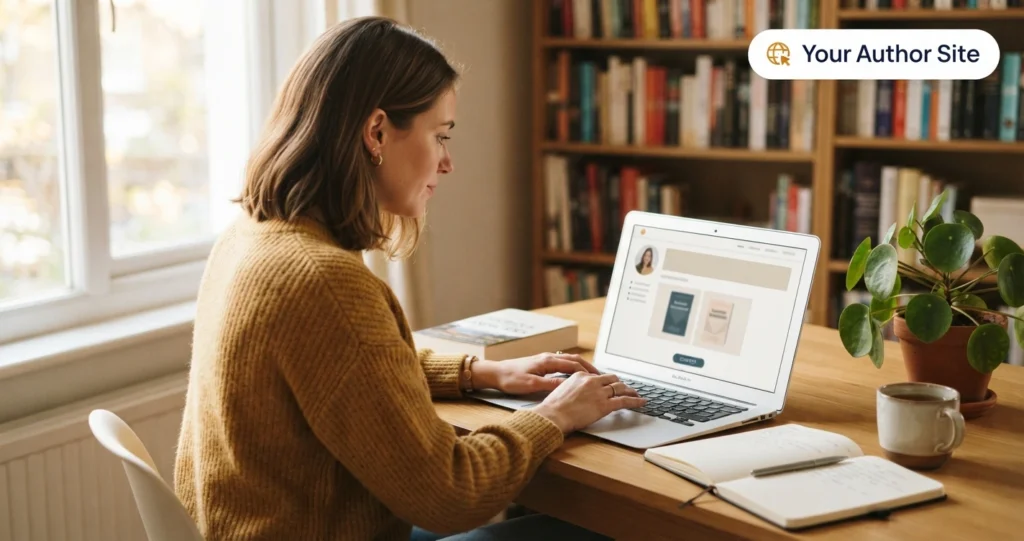
Before a reader buys your book, a journalist invites you to speak or a publisher replies to your pitch, they usually do the same thing: they search your name. What they find decides whether they take the next step. An author website gives that search one clear, current place to land. This guide explains why it matters, what to put on it, and how to get it found.
Quick Answer
Yes, most authors benefit from having an author website, because it is the one place you control. A good one has:
- A short, clear author bio that says who you are and what you write
- A books page with covers, descriptions and links to buy
- A press and media page for interviews, reviews and appearances
- A simple contact or booking form
- A way to join your email list, if you plan to write to readers
Why an Author Website Matters
Social profiles and retailer pages are useful, but you do not control them. A retailer page shows one book and sells it, and a social profile can change its rules or disappear. Your own site can show all your books, your bio, your press and a way to reach you, in your voice. It also gives search engines a main page about you, which helps when people look for your name, especially if someone else shares it.
What to Put on an Author Website
Home page. Say in one or two sentences who you are and what you write. Show your latest book and one clear next step, such as “Read the first chapter” or “Join the list”.
Author bio. Write a short version of three or four sentences and a longer one. Include what you write about, one or two credibility points that are true and checkable, and a recent photo. Readers and event organisers often copy this text, so keep it current.
Books. Give each book its own section with the cover, a short description, and buy links for the stores that sell it. Use links to the retailer pages, so the sale happens where readers already trust the checkout.
Press and media. Collect interviews, reviews, podcasts and appearances in one place, with links. It shows that others have covered your work, and it helps people confirm you are the right person. Only list coverage that is real, and label sponsored pieces as sponsored.
Contact or speaking. Add a short form so event organisers, journalists and readers can reach you. A form protected against spam bots keeps your inbox clean.
Email sign-up. If you plan to keep in touch, offer a short, honest reason to join, such as a sample chapter or news of new books. Only email people who opted in, and make unsubscribing easy.
What Google Says Helps a Small Site Get Found
You do not need tricks. Google’s SEO starter guide lists the basics, and they apply directly to an author site:
- Page titles: make each one unique to the page, clear and concise, and an accurate description of it. Put your name and what the page is about in it.
- Meta descriptions: keep them short and unique to the page. Google may use them as the snippet in results, or may choose its own text from the page.
- Helpful content: the guide says this likely matters more than any other suggestion. Write clear, well-organised pages, keep them up to date and do not copy other people’s text.
- Links: use descriptive link text, so readers know where a link leads, and link to trustworthy sources.
- Images: use sharp, clear images near the related text, with descriptive alt text. Your book cover needs alt text that says what it is.
- Measure it: set up Google Search Console, which is free, to see how people find your site. The guide also says changes can take hours or months, and suggests waiting a few weeks before judging whether something worked.
Be patient. Search engines take time to trust a new site, and no one can promise a ranking. Steady, useful pages and honest links matter more than tricks.
Check Your Own Author Website
Tick what your site already has. The checklist scores itself in your browser and saves nothing.
Author website readiness checklist
Score: 0 of 9
Tick the boxes to see your score.
Common Mistakes
- An out-of-date bio, or a "coming soon" page that never gets finished
- Burying the buy links, or having no clear next step
- Claims you cannot prove, such as "bestselling" without a source
- Copying text from a retailer page, which can look the same as hundreds of other sites
Frequently Asked Questions
Do I need an author website if I only have one book? It still helps, because readers and reviewers search your name. One page with your bio, your book and a way to reach you is a good start.
How long before my site shows in Google? Google's own guide says changes can take hours or months, so give it a few weeks before judging.
Is a retailer page enough? It shows one book and you do not control it. A site you own can show everything and stay in your voice.
The Bottom Line
An author website does not need to be large. It needs to be clear, current and yours. Start with a bio, a books page, a press page and a contact form, then grow it as your work grows.
If you would like help, see how our personal website service works or book a free consultation for a look at how you appear in search today. You also may find our guide on whether an author or professor qualifies for a Wikipedia page useful, since independent coverage matters for both.
Source: Google Search Central, SEO starter guide. This article is general information. No one can guarantee search rankings, sales or media coverage.